
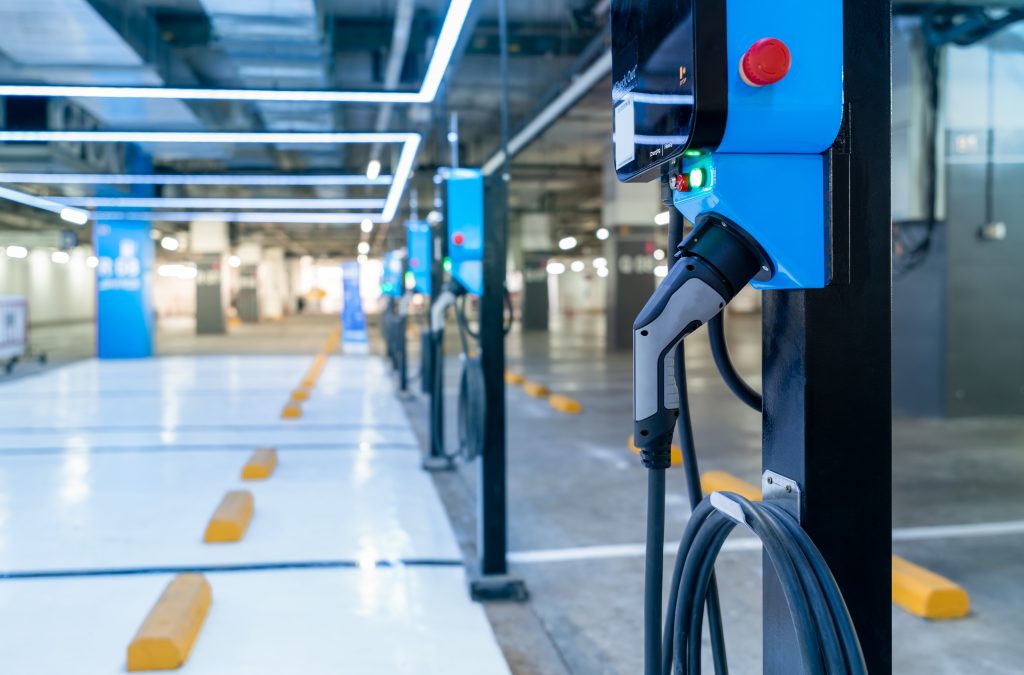
EV charging stations are becoming a standard fixture in commercial parking lots, and the rules for striping and signage are catching up just as fast. A property manager who installs charging equipment without thinking through the layout, the colors, and the required signage can end up with a station that violates code, blocks accessibility routes, or simply confuses drivers. The good news is that the standards are settling into a clear pattern. Here is what to know about EV charging station striping and signage for commercial parking lots.
Why EV Station Layout Matters
EV charging stations have to work as both parking spaces and equipment installations. The charger needs to be accessible via the cable, the car needs to be parked in the correct orientation, and other drivers need to know which spaces are for charging only. Get the layout wrong, and the station gets used as general parking, blocked by carts and trash, or skipped by drivers who cannot tell which spaces are dedicated.
The right layout starts with two questions. How are drivers approaching the space, and where is the charging equipment relative to the vehicle?
Striping and Color Conventions
The most common color convention for EV charging stalls is green. Some properties paint the entire stall green. Others use a green border with the EV symbol stenciled in the middle. Both approaches make the dedicated stall obvious from across the lot.
Typical components of an EV station striping layout:
- Standard stall lines in white or yellow, matching the rest of the lot
- A painted EV charging symbol or text inside the stall
- A green border, full green fill, or green diagonal stripes to distinguish the space
- Directional arrows if the charger requires a specific parking orientation
- A buffer zone or no-park area around the charging equipment
Color conventions are not federally mandated for non-accessible stalls, but green has become the industry default and matches what drivers expect.
ADA Requirements for Accessible EV Stations
EV charging stations are subject to the same accessibility expectations as the rest of the parking lot. At sites with multiple chargers, at least one accessible EV station is typically required. Our article on ADA parking lot compliance covers the general standards. For EV-specific accessible stations, the layout needs:
- A vehicle space and access aisle sized to ADA accessible parking standards
- An accessible route from the charging space to nearby paths and entrances
- A clear, level operating area around the charging equipment so a wheelchair user can plug in
- Signage with the International Symbol of Accessibility, along with the EV symbol
State and local codes can go further than federal minimums. California and several other states have their own specific rules for accessible EV stations. Federally funded projects carry additional requirements. Always check current local rules before finalizing the layout.
Signs Drivers and Enforcers Will Use
Signs at EV stations serve two audiences. Drivers need to know the space is for charging. Enforcement personnel need clear language to ticket or tow illegally parked vehicles.
A complete EV signage package usually includes:
- “EV Charging Only” or “Reserved for Electric Vehicle Charging” sign
- Time limits, if the site enforces them (some lots cap charging at two or four hours)
- Tow-away language where local enforcement requires it
- Accessible-EV signage where applicable
- Wayfinding to the charging stations from the parking entrance on larger sites
State EV signage laws vary. Indiana and several other states have a model sign language that satisfies enforcement standards. Local codes can add further requirements.
Plan Your EV Layout the Right Way
Otto’s Parking Marking handles both the striping and the signage side of EV charging station installations. Call 317.882.8933 or 800.888.7996, or request a quote to start your project.